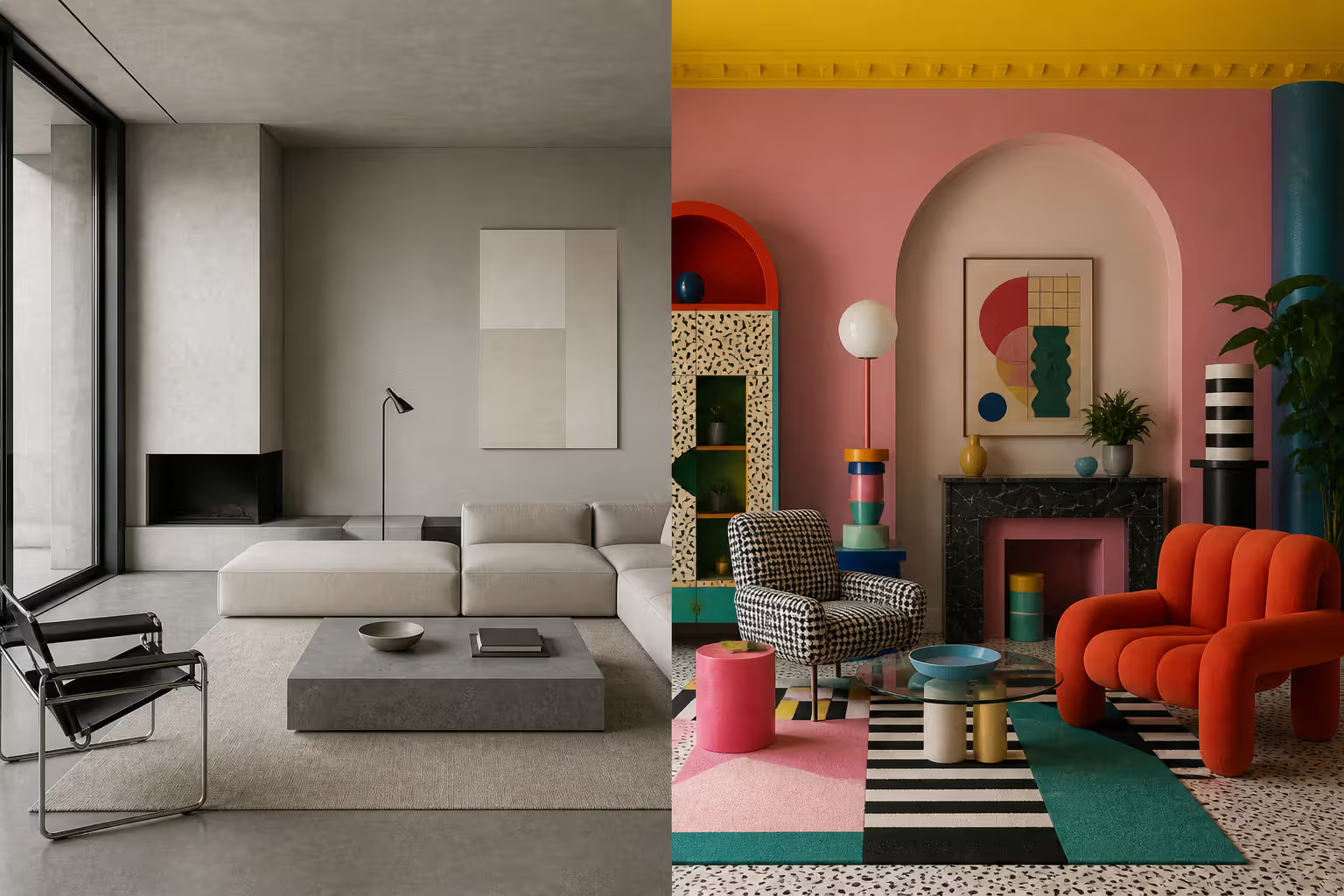
Modernism transformed the visual landscape of the 20th century, replacing centuries-old artistic conventions with radical new forms. From the glass-and-steel skyscrapers that define city skylines to the abstract paintings hanging in major museums, modernist principles continue shaping how we create and experience art, architecture, and design. Understanding this movement means grasping not just an aesthetic shift, but a fundamental reimagining of what art could be and whom it should serve.
Defining Modernism as an Artistic and Cultural Movement
Modernism represents a sweeping artistic and cultural movement that dominated Western creative output roughly from the 1880s through the 1970s. At its core, modernism definition in art centers on a deliberate break from historical precedent—a conscious rejection of the ornate styles, academic rules, and representational traditions that had governed European art since the Renaissance.
The movement spanned virtually every creative discipline. Painters abandoned realistic depiction for abstraction. Architects stripped buildings of decorative moldings and classical columns. Writers experimented with stream-of-consciousness narratives. Composers discarded traditional harmony. What unified these diverse experiments was a shared conviction: art must reflect the realities of modern life rather than imitate the past.
Modernism as cultural period coincided with unprecedented technological and social upheaval. The movement emerged when horse-drawn carriages gave way to automobiles, when electric lights replaced gas lamps, when mass production fundamentally altered how objects entered people's lives. Modernist artists believed their work should embody this new world—its speed, its rationality, its machine-made precision.
The timeframe varies slightly depending on the medium. In visual arts, modernism's roots stretch back to Impressionism in the 1860s-70s, though the movement gained full momentum around 1900. Architecture's modernist phase crystallized somewhat later, hitting its stride in the 1920s-30s with the International Style. By the late 1960s and early 1970s, postmodern reactions began challenging modernist orthodoxy, though modernist principles never disappeared entirely.
Author: Olivia Hartwell;
Source: crafterholic.com
Historical Origins and Social Context of Modernism
The origins of modernist movement lie in the profound dislocations of late 19th-century Europe and America. Industrialization had transformed agrarian societies into urban manufacturing centers within a single generation. By 1900, more than half of England's population lived in cities—a ratio unthinkable a century earlier. This rapid urbanization created entirely new visual experiences: crowded streets, factory smokestacks, department store window displays, electric advertising signs.
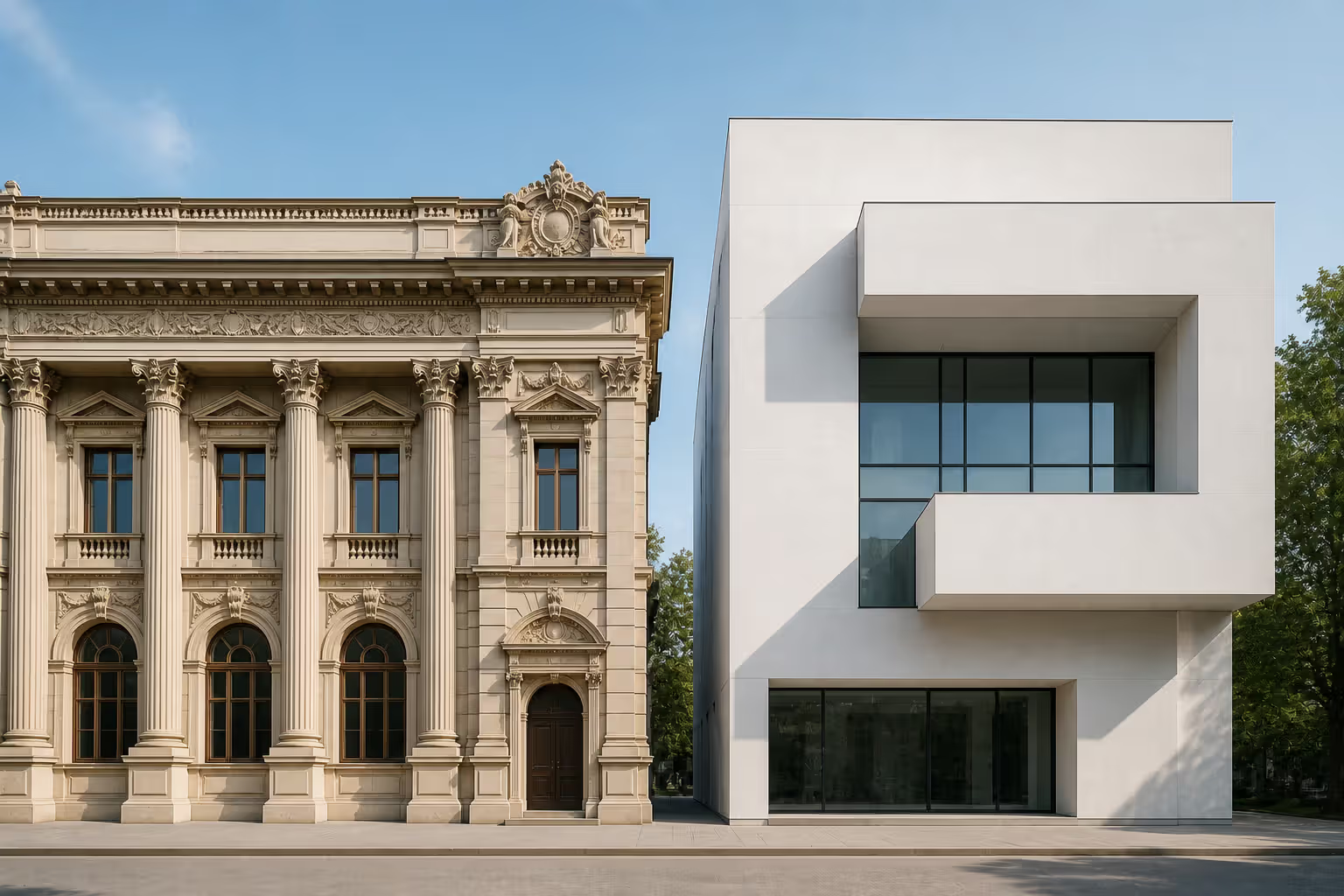
Traditional artistic styles seemed inadequate for capturing this transformed reality. Academic painting still depicted mythological scenes and aristocratic portraits using techniques perfected in the 1600s. Architecture relied on Gothic Revival or Beaux-Arts ornamentation that had no relationship to modern building technologies like steel-frame construction or reinforced concrete. A growing number of artists recognized this disconnect between inherited forms and contemporary life.
The social context of modernism included the declining authority of established institutions. The Catholic Church, European monarchies, and classical academies—all had dictated artistic standards for centuries—faced challenges from secular, democratic, and scientific worldviews. Darwin's theory of evolution questioned religious creation narratives. Photography threatened painting's monopoly on visual representation. Mass-produced goods undercut traditional craftsmanship.
World War I (1914-1918) accelerated modernism's trajectory by shattering faith in 19th-century progress narratives. The war's industrial-scale slaughter—machine guns, poison gas, aerial bombardment—made romantic heroism seem naive. Many artists concluded that radical formal innovation was the only honest response to a world that had revealed such capacity for mechanized destruction.
Modernism and industrialization maintained a complex relationship. Some modernists celebrated industrial production as a democratizing force that could bring good design to ordinary people. The Bauhaus school in Germany (1919-1933) explicitly sought to unite art and mass manufacturing. Other modernists viewed industrialization more ambivalently, recognizing both its efficiency and its potential for dehumanization.
Core Philosophical Ideas Behind Modernism
Several interconnected concepts formed the intellectual foundation of modernist practice. Understanding these key ideas behind modernism clarifies why the movement took the forms it did.
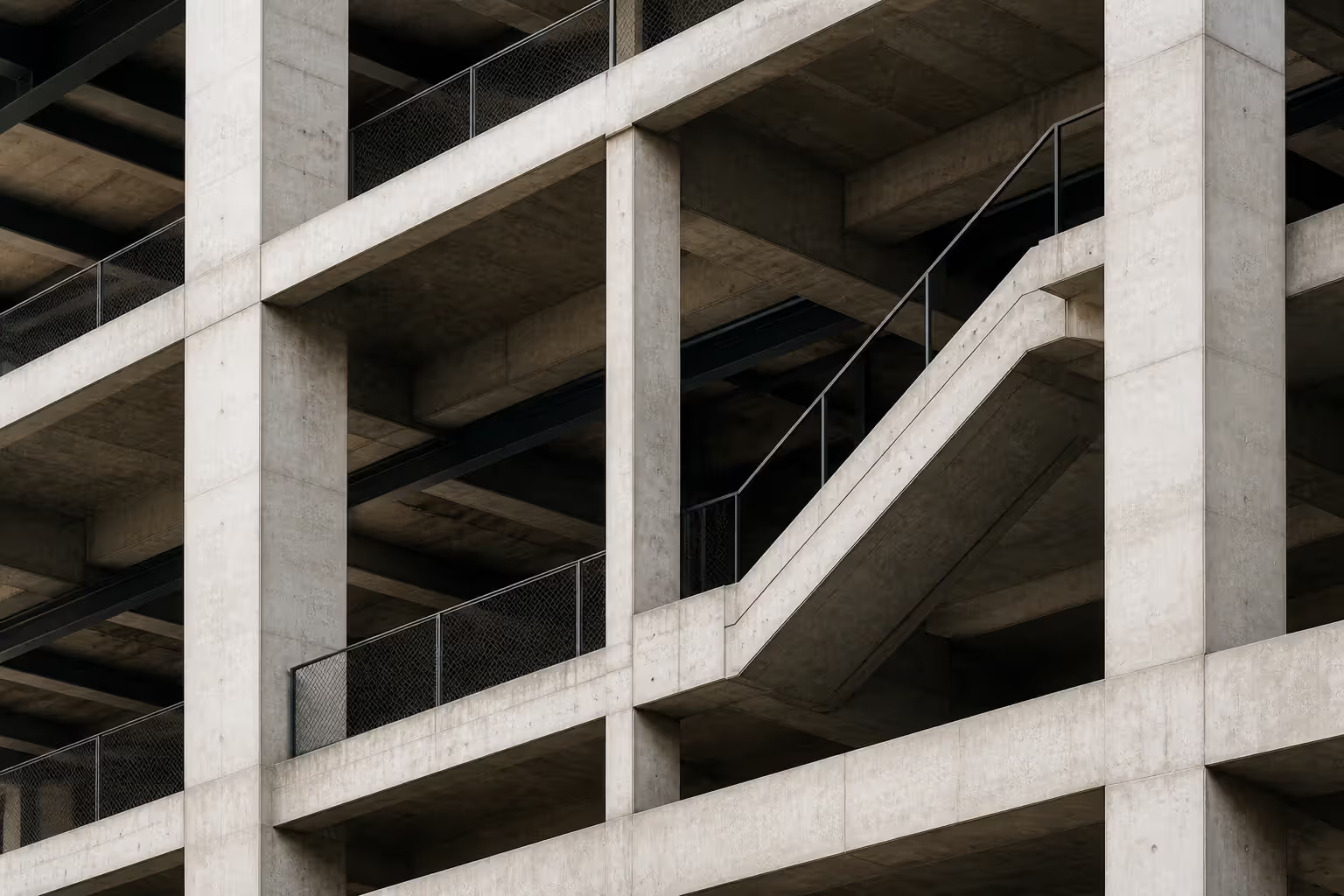
Truth to materials became a modernist mantra. Artists and designers believed each medium possessed inherent properties that should be honestly expressed rather than disguised. Concrete should look like concrete, not be covered with marble veneer. A painting should acknowledge its flatness rather than create illusionistic depth. This principle led architects to expose structural elements—steel beams, concrete columns—that previous generations would have hidden behind decorative cladding.
Author: Olivia Hartwell;
Source: crafterholic.com
Rationalism in modernism elevated logical thinking and scientific method over emotion, tradition, or religious authority. Modernists trusted that reasoned analysis could solve design problems objectively. The architect Ludwig Mies van der Rohe's dictum "less is more" reflected this rationalist faith: eliminate unnecessary elements, and the pure essence of a building or object would emerge. This approach assumed universal principles of good design existed, discoverable through clear thinking.
Form follows function summarized modernist priorities in a three-word phrase. Coined by architect Louis Sullivan in the 1890s, this principle held that an object's appearance should derive logically from its purpose. A chair's shape should reflect how the human body sits. A building's exterior should express its internal organization. Decoration applied afterward—unrelated to structural or functional requirements—violated this fundamental rule.
The rejection of ornament in modernism reached its most extreme expression in Adolf Loos's 1908 essay "Ornament and Crime." Loos argued that applied decoration represented cultural backwardness, comparing it to primitive tattooing. He wrote:
The evolution of culture is synonymous with the removal of ornament from utilitarian objects.
— Adolf Loos
While few modernists shared Loos's moralistic fervor, most agreed that ornament served no purpose in a rational, machine-age aesthetic. Decoration added cost without improving function. It accumulated dust. It distracted from essential forms. Better to eliminate it entirely.
This anti-ornament stance had practical dimensions beyond philosophy. Smooth, undecorated surfaces suited mass production techniques. Machines could stamp out identical components far more easily than craft workers could carve unique decorative details. Modernist aesthetics thus aligned with industrial capitalism's drive for efficiency and standardization.
Modernism in Visual Culture and the Arts
Modernism in visual culture manifested differently across media, yet shared common threads of experimentation and tradition-breaking.
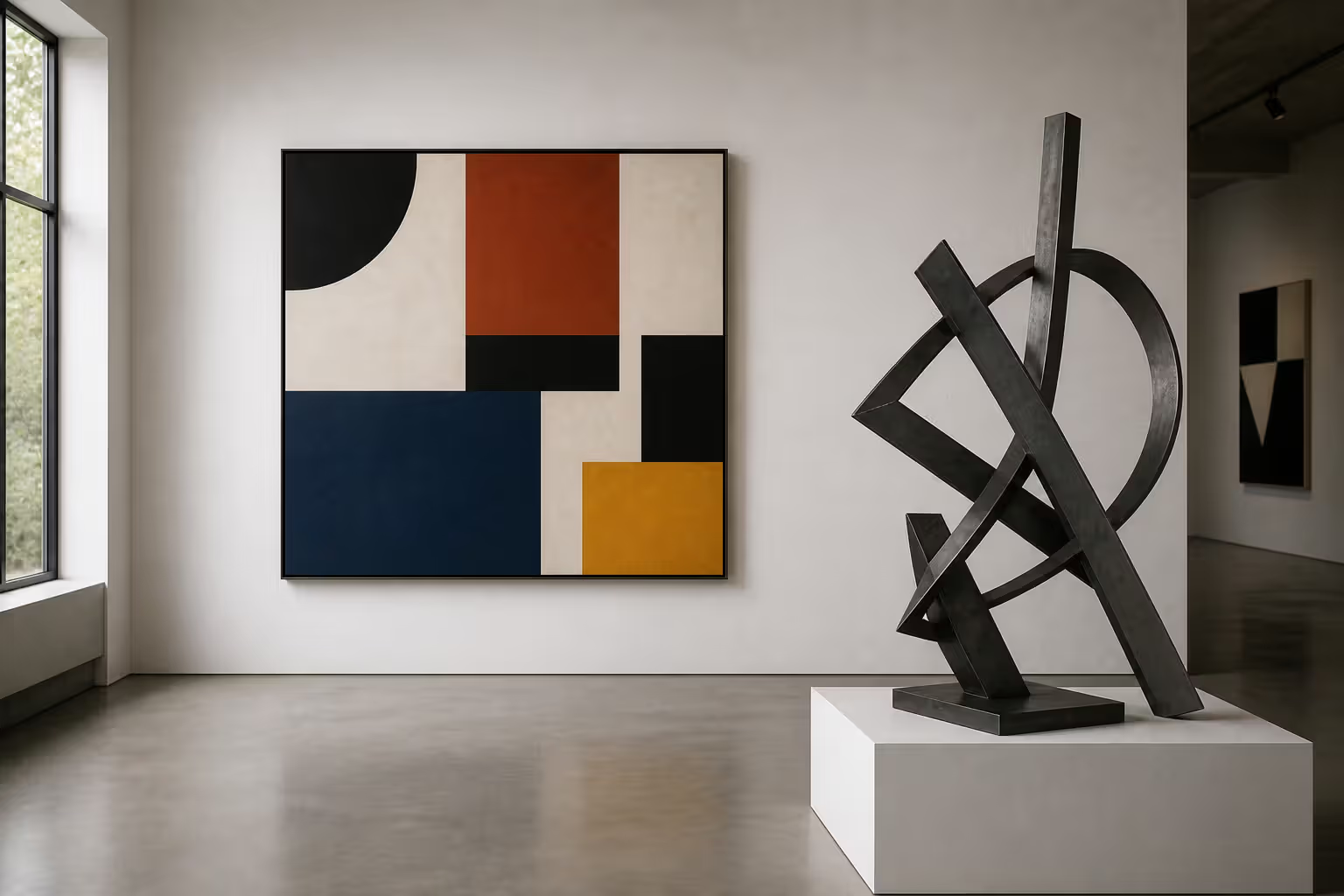
In painting, successive movements pushed further into abstraction. Cubism (pioneered by Pablo Picasso and Georges Braque around 1907-1914) shattered objects into geometric fragments, showing multiple viewpoints simultaneously. Piet Mondrian reduced compositions to grids of primary colors and black lines. Wassily Kandinsky eliminated recognizable subject matter entirely, creating purely abstract arrangements of color and form.
Sculpture followed similar trajectories. Constantin Brancusi simplified forms to their essential geometric shapes—his "Bird in Space" series distilled avian flight into polished bronze curves. Constructivist sculptors like Naum Gabo built abstract compositions from industrial materials: plastic, glass, metal.
Architecture became modernism's most visible and controversial arena. The International Style, codified in the 1920s-30s, established a visual language of flat roofs, white walls, ribbon windows, and open floor plans. Le Corbusier designed houses as "machines for living"—efficient, hygienic, stripped of historical references. Walter Gropius and Mies van der Rohe brought these principles to the United States, where they shaped corporate headquarters and public housing projects alike.
Graphic design embraced modernist clarity through movements like De Stijl and the Bauhaus. Designers favored sans-serif typefaces, asymmetric layouts, and primary colors. Information should communicate directly, they believed, without decorative interference.
Rejection of Ornament and Embrace of Minimalism
The practical application of anti-ornament principles created the clean-lined aesthetic now synonymous with modernism. Compare a Victorian house—with its gingerbread trim, decorative brackets, and varied surface textures—to a modernist home: smooth white walls, unadorned windows, geometric simplicity.
This minimalism extended to interiors. Modernist furniture featured tubular steel, molded plywood, and leather—materials chosen for durability and ease of cleaning rather than traditional craftsmanship. Marcel Breuer's Wassily Chair (1925) reduced seating to its structural minimum: a steel frame with canvas slings. No carved wood, no upholstered bulk, no decorative tufting.
Critics accused modernism of coldness and sterility. Minimalist spaces could feel institutional rather than homely. The absence of ornament sometimes created visual monotony. By the 1960s, even some modernists acknowledged that complete ornament-rejection produced harsh, unwelcoming environments.
Author: Olivia Hartwell;
Source: crafterholic.com
The Role of Industrialization in Modernist Aesthetics
Industrial production methods fundamentally shaped what modernist objects looked like. Machine manufacturing favored repetition, standardization, and geometric precision—exactly the qualities modernist designers celebrated.
The Barcelona Chair, designed by Mies van der Rohe in 1929, exemplifies this relationship. Its chrome-plated steel frame could be fabricated using industrial metalworking techniques. Its leather cushions employed standardized dimensions. While actually quite expensive to produce (ironically, it required skilled hand-finishing), the chair looked machine-made—and that visual quality mattered to modernist sensibilities.
Prefabrication became a modernist ideal. If housing components could be mass-produced in factories and assembled on-site, costs would drop and quality would improve. Le Corbusier proposed standardized apartment units stacked into high-rise towers, freeing ground-level space for parks. These visions rarely achieved their utopian promises—prefab housing often proved neither cheap nor popular—but they demonstrated modernism's faith in industrial solutions.
Modernism vs Postmodernism
By the 1960s, a new generation of artists, architects, and theorists began questioning modernist assumptions. This emerging postmodern sensibility rejected many core modernist beliefs, creating a fundamental shift in cultural production.
Aspect
Modernism
Postmodernism
Philosophy
Universal truths exist and can be discovered through reason
Truth is relative, contextual, and socially constructed
Approach to tradition
Break with the past; innovation is paramount
Embrace historical reference, pastiche, and irony
Aesthetics
Purity, simplicity, abstraction
Complexity, contradiction, ornamentation
Use of ornament
Rejected as unnecessary and dishonest
Welcomed as playful, communicative, and meaningful
Attitude toward mass culture
High art should remain separate from commercial culture
Blur boundaries between high and low culture
Time period
Approximately 1880s–1970s
Approximately 1960s–present (though influence has waned since 2000s)
Postmodern architects like Robert Venturi argued that modernist buildings were boring and elitist. His 1972 book "Learning from Las Vegas" suggested commercial vernacular architecture—neon signs, decorated sheds—contained valuable lessons modernists ignored. Venturi's famous rejoinder to Mies van der Rohe declared "less is a bore," championing complexity over minimalist reduction.
Where modernists sought timeless universals, postmodernists emphasized cultural specificity and historical context. A building in Tokyo need not look identical to one in New York. Historical references weren't dishonest—they communicated meaning and created connections with users. Ornament could be witty, ironic, or simply enjoyable.
The philosophical differences ran deep. Modernism's rationalism assumed objective design solutions existed. Postmodernism's relativism questioned whether any single approach could claim universal validity. Modernism trusted expert knowledge and professional authority. Postmodernism democratized taste, suggesting ordinary people's preferences mattered as much as trained designers' judgments.
In practice, the shift wasn't absolute. Many architects and designers continued working in modernist idioms well past 1970. Conversely, some postmodern tendencies—playfulness with historical forms, interest in popular culture—appeared earlier than the conventional timeline suggests. Cultural movements rarely follow neat chronological boundaries.
Author: Olivia Hartwell;
Source: crafterholic.com
Why Modernism Still Matters Today
Despite postmodern critiques and the rise of subsequent movements, modernist principles remain deeply embedded in contemporary visual culture as of 2026. Understanding modernism helps decode the designed environment we inhabit daily.
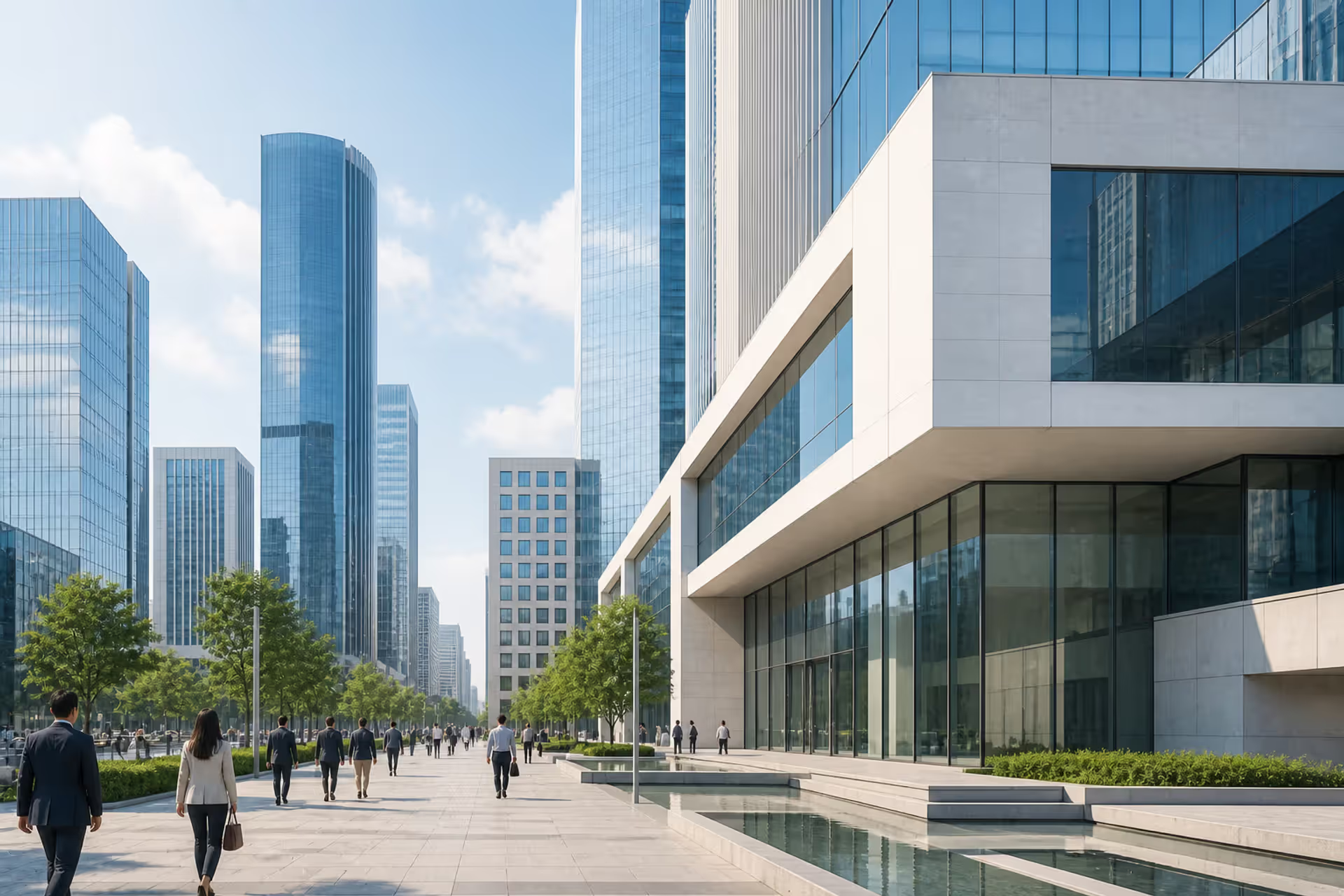
Modernist architecture dominates cityscapes worldwide. Glass-curtain-wall office towers—direct descendants of 1950s-60s International Style buildings—continue rising in business districts. Residential developments frequently employ modernist vocabularies: flat roofs, open floor plans, floor-to-ceiling windows. Even when architects add postmodern or contemporary flourishes, the underlying spatial logic often remains modernist.
Graphic design and digital interfaces owe enormous debts to modernist clarity. The sans-serif typefaces on your smartphone, the grid-based layouts of websites, the preference for white space and minimal decoration—all reflect modernist design principles adapted to digital media. Apple's product design philosophy, emphasizing simplicity and material honesty, descends directly from Bauhaus ideals.
Contemporary art continues engaging with modernist questions about abstraction, medium-specificity, and the relationship between form and content. While few artists today would call themselves pure modernists, the movement established frameworks—What is painting? What can sculpture be?—that remain relevant.
The sustainability movement has rediscovered some modernist values. Durability over disposability, honest materials over veneers, functional efficiency over wasteful excess—these principles align with environmental concerns. Modernism's failures (particularly in urban planning and public housing) offer cautionary lessons, but its successes in creating beautiful, functional objects from modest means retain appeal.
Critically examining modernism also reveals its limitations and blind spots. The movement's universalist claims often masked culturally specific (particularly Western European) assumptions. Its embrace of industrialization sometimes produced dehumanizing environments. Its rejection of ornament could feel authoritarian, imposing elite tastes on people who enjoyed decoration. Recognizing these problems doesn't invalidate modernism's achievements, but contextualizes them more honestly.
Frequently Asked Questions About Modernism
What are the main characteristics of modernism?
Modernism emphasizes breaking with historical tradition, embracing abstraction and simplification, rejecting applied ornament, celebrating industrial materials and production methods, and seeking universal principles through rational analysis. Visually, this typically produces clean lines, geometric forms, minimal decoration, and honest expression of materials and structure.
When did the modernist movement begin and end?
Modernism emerged gradually in the late 19th century (1880s-1890s) and dominated Western art and design through the mid-20th century, reaching peak influence in the 1920s-1960s. The movement declined in the 1970s as postmodern alternatives gained traction, though modernist approaches never disappeared entirely and continue influencing contemporary practice.
How did industrialization influence modernism?
Industrialization provided both practical methods and philosophical inspiration for modernism. Mass production techniques favored the standardized, unornamented forms modernists championed. Factory-made materials like steel, glass, and concrete enabled new structural possibilities. Conceptually, industrial efficiency became an aesthetic ideal—modernists sought to design objects and buildings with machine-like precision and rationality.
What is the difference between modernism and postmodernism?
Modernism seeks universal truths through reason, rejects historical tradition and ornament, and maintains clear boundaries between high art and popular culture. Postmodernism questions universal truths, embraces historical references and decoration, and blurs distinctions between elite and mass culture. Aesthetically, modernism favors simplicity and purity while postmodernism celebrates complexity and contradiction.
Why did modernists reject ornamentation?
Modernists viewed ornament as dishonest addition that concealed essential forms and served no functional purpose. They believed decoration represented outdated craft traditions incompatible with industrial production. Philosophically, ornament-rejection reflected rationalist faith that pure, unadorned forms possessed inherent beauty. Practically, eliminating decoration reduced costs and simplified mass manufacturing.
Who were the key figures in modernist art and design?
Major modernist figures include architects Le Corbusier, Ludwig Mies van der Rohe, and Walter Gropius; painters Pablo Picasso, Piet Mondrian, and Wassily Kandinsky; sculptors Constantin Brancusi and Naum Gabo; designers Marcel Breuer and Eileen Gray; and theorists Adolf Loos and Clement Greenberg. Each contributed distinct innovations while sharing core modernist commitments to abstraction, rationalism, and tradition-breaking.
Modernism represents one of the most consequential artistic and cultural movements in human history, fundamentally reshaping how we design buildings, create art, and organize visual information. Its core principles—rationalism, functionalism, rejection of ornament, embrace of industrial materials—emerged from specific historical circumstances: rapid industrialization, urbanization, and the collapse of traditional authorities in the late 19th and early 20th centuries.
The movement's legacy remains visible everywhere in 2026, from the skyscrapers defining urban skylines to the interfaces on digital devices. While postmodern critiques exposed modernism's limitations—its sometimes rigid universalism, its occasional coldness, its blind spots regarding cultural difference—the movement's achievements endure. Modernism proved that design could be both beautiful and functional, that art could honestly reflect contemporary life rather than imitate the past, and that clarity and simplicity possess their own powerful aesthetics.
Understanding modernism means recognizing both its revolutionary contributions and its shortcomings. The movement democratized access to well-designed objects through mass production, yet sometimes imposed elite tastes on unwilling populations. It created stunning architectural icons, yet also produced failed housing projects. It liberated artists from academic conventions, yet established new orthodoxies that could feel equally constraining.
For anyone interested in art, architecture, design, or visual culture, grappling with modernism remains essential. The movement established questions and frameworks that continue shaping creative practice: How should form relate to function? What role should tradition play in contemporary work? Can design improve society? These debates, first articulated by modernist pioneers over a century ago, still resonate today.
Visual language uses color, shape, typography, and imagery to communicate ideas instantly. Discover how visual elements function as a communication system, how semiotics creates meaning in design, and how to apply graphic communication principles across media effectively.
Discover how mathematical proportions like the golden ratio (1.618), rule of thirds, and aspect ratios create visual balance in design. Learn practical applications, compare popular ratio systems, and avoid common mistakes when applying proportional design principles to logos, layouts, and interfaces.
Proximity gestalt describes how the brain groups nearby visual elements automatically. This guide explains the psychology behind the proximity principle, demonstrates practical spacing strategies, compares proximity with other Gestalt laws, and provides actionable best practices for designers.
A single page can carry an entire pitch, summarize a complex project, or distill a career into a scannable snapshot. This guide breaks down proven layout frameworks, hierarchy techniques, and composition strategies to help you create one-pagers that communicate fast and stick.
The content on this website is provided for general informational and educational purposes only. It is intended to explain concepts related to digital design, visual art, color theory, art techniques, design principles, and design history.
All information on this website, including articles, guides, and examples, is presented for general educational purposes. Creative outcomes may vary depending on individual skill, tools, and practice.
This website does not provide professional design services or guarantee results, and the information presented should not be used as a substitute for formal education or professional consultation.
The website and its authors are not responsible for any errors or omissions, or for any outcomes resulting from decisions made based on the information provided on this website.