Here's something that confuses most people: a conceptual artist might spend six months on a piece and never touch a paintbrush, chisel, or camera. The "work" happens entirely in their head.
That chair you're sitting on? A conceptual artist once put one in a gallery next to a photo of a chair and a dictionary page defining "chair." Nothing was painted. Nothing was sculpted. Joseph Kosuth's "One and Three Chairs" from 1965 just asked: which of these three things is actually the chair? The physical object, its image, or the definition?
That's conceptual art. The mental puzzle matters more than making beautiful things. While a traditional painter obsesses over getting the light just right, a conceptual artist obsesses over whether the entire idea of "getting the light right" still means anything.
This challenged everything. Art dealers prefer selling objects—how do you sell a thought? Museums want things to display behind glass—where do you put an idea? The entire system got uncomfortable, which was precisely the point.
Defining Conceptual Art and Its Core Philosophy
Think of conceptual art this way: the artwork lives in your brain, not on the wall.
Traditional definitions talk about "prioritizing concept over execution," but that's textbook language. Really, it means the artist considers their job done once they've worked out the idea. Everything after that—painting it, photographing it, performing it—is just showing their homework.
Lucy Lippard and John Chandler noticed this in 1968. They watched art literally evaporate. Paintings became typed instructions. Sculptures became telephone calls. Gallery exhibitions turned into manila folders with certificates. They called it "dematerialization"—art shedding its physical body like a ghost leaving a corpse.
Why would anyone do this? Several reasons, actually.
First, it fought back against treating art like stocks and bonds. Can't easily auction off an idea. Can't hang it in a billionaire's living room to impress guests. The whole "art as investment" thing falls apart when there's nothing physical to lock in a vault.
Second, it made art theoretically accessible to everyone. You don't need a $50,000 studio or years learning to mix colors. You need a brain and something to say. (Whether this actually democratized art is debatable—more on that later.)
Third, and this mattered to artists in the 1960s, it felt like painting and sculpture had run out of road. How many more variations on abstract expressionism could anyone stand? Real innovation required questioning what art even was.
Sol LeWitt laid this out in 1967. His essay "Paragraphs on Conceptual Art" argued that once you've figured out your concept, actually making the thing becomes almost irrelevant—just following your own recipe. The real creative work happened during the thinking phase, not the doing phase.
That statement flipped centuries of art tradition upside down. Imagine telling Michelangelo that carving the David was "just following instructions" and the real art was the initial idea. He'd have chased you out of Florence with a chisel.
But LeWitt meant it. His wall drawings consisted of instructions like "draw all possible straight lines connecting points on a grid." Anyone could execute them. Museums hire people to redraw them when exhibitions change. The concept—exploring systematic permutations—is the art. The lines on the wall? Just evidence it happened.
Author: Olivia Hartwell;
Source: crafterholic.com
How Conceptual Artists Approach Their Work
Watch a conceptual artist at work and you'll think they're procrastinating. They're reading philosophy books. Taking notes. Staring at walls. Having coffee conversations. Where's the art?
That is the art.
While a sculptor spends months casting bronze, a conceptual artist spends months thinking about what bronze means. The cultural history of the material. Its associations with monuments and permanence. Whether using it ironically comments on something worth saying.
Then they might not use bronze at all. Or they'll write instructions for a bronze sculpture and never cast it, because the proposal contains everything important.
Different artists develop concepts differently. Some spend years researching before making anything visible. An artist exploring labor conditions might actually work factory shifts for months, documenting the experience through notes that eventually inform the concept. The final piece could be a single photograph, but it represents hundreds of hours of invisible work.
Others use rigid systems or algorithms. "Walk one mile following every sidewalk crack" becomes both instruction and artwork. The artist might do it themselves, hire someone else, or just publish the instructions. All three versions count as the artwork because the concept survives regardless of who executes it.
Dear Friend, I am black. I am sure you did not realize this when you made/laughed at/agreed with that racist remark.
— Adrian Piper
She'd hand them out in situations where people assumed she was white. The cards were the artwork. Simple, direct, conceptually powerful.
Many conceptual artists keep notebooks crammed with ideas they'll never execute. Some publish these notebooks as artworks themselves—exposing the thinking process, showing concepts evolving through sketches and revisions. This transparency deliberately undermines romantic myths about artistic inspiration striking like lightning.
Here's something traditional artists find infuriating: some concepts work better unbuilt. A proposal can be more powerful than execution. Imagine an artwork that's just a detailed plan for something impossible. The concept thrives specifically because it can't physically exist. Trying to build it would ruin everything.
Author: Olivia Hartwell;
Source: crafterholic.com
Key Characteristics of Conceptual Artists
You can spot conceptual artists by what they read as much as what they make.
Their bookshelves contain philosophy, linguistics, sociology, critical theory. A painter might read about color theory. A conceptual artist reads Foucault's analysis of power structures, then figures out how to turn that into an artwork about museum security guards.
They're comfortable with art that disappears. A performance that happens once and leaves nothing behind except memories and maybe some photographs? Perfect. An instruction set that anyone can execute differently each time? Even better. They don't need their work to appreciate in value or survive centuries.
Most conceptual artists actively question the systems that validate art. They'll create pieces specifically about how galleries decide what to exhibit, or how auction houses determine prices, or how museums choose what to preserve. The institution itself becomes subject matter.
This creates awkward situations. The same galleries and museums they critique still want to show their work. So you get conceptual artists making institutional critiques... inside institutions... that paid for the critique. The contradictions are sometimes the point.
Communication matters more than self-expression. A traditional artist might paint their feelings about heartbreak. A conceptual artist investigates how heartbreak gets represented in culture, media, or language. The personal becomes analytical.
Skills-wise? Critical thinking tops the list. You need to develop ideas with genuine rigor, not just vague notions you dress up with fancy language. Many conceptual artists write extensively—clear articulation separates strong concepts from muddled ones.
Technical abilities still help. Knowing photography, video, fabrication, or coding expands your options for realizing concepts appropriately. But you choose techniques to serve ideas, not to show off mastery.
One thing conceptual artists don't do: make sloppy work and claim "the concept justifies it." If your idea requires meticulous execution, do it meticulously. If your concept works best with raw, unpolished presentation, that's different. The execution should match the concept's needs.
Concept vs Form: Why Ideas Matter More Than Objects
Every art form balances concept and execution differently. For most artists, they develop together—a painter's idea evolves through the physical act of painting. Separate them and you lose something.
Conceptual art deliberately forces that separation, then declares: the idea wins.
This creates real trade-offs. On one hand, you can address incredibly complex subjects. Political systems, philosophical problems, linguistic structures—things that resist being turned into pretty pictures. On the other hand, you risk alienating anyone who came to experience beauty, craft, or emotional resonance.
Aspect
Traditional Artists
Conceptual Artists
Primary Focus
Technical mastery and aesthetic refinement
Intellectual development and theoretical clarity
Materials
Specific media requiring specialized skills (oil paint, marble, film)
Whatever serves the concept best (text, instructions, found objects, events)
Final Product
A unique object with inherent visual or sensory value
Documentation of an idea, temporary event, or reproducible instruction set
Viewer Role
Respond emotionally and aesthetically to what they see
Engage intellectually with ideas, question assumptions
Conceptual rigor, challenging conventions, provoking thought
Real practice is messier than this table suggests. Plenty of contemporary artists blend both approaches—developing strong concepts and executing them with sophisticated craft. The categories aren't teams you join; they're priorities shaping your decisions.
Ideas can be everywhere simultaneously. A painting exists in one location (or maybe a few if you count reproductions). An idea, once articulated, belongs to anyone who encounters it. This bothered some artists who saw art's exclusivity as a problem worth solving.
Ideas also resist becoming luxury commodities, at least in theory. Art markets proved surprisingly adaptable—galleries figured out how to sell certificates and documentation—but conceptual art made commodification awkward. That awkwardness aligned with artists questioning capitalism's influence on culture.
Form hasn't vanished from conceptual practice. It's been repositioned as a strategic choice. The best conceptual works choose forms that amplify their ideas. A piece about bureaucratic absurdity might use official-looking documents and rubber stamps. A work about surveillance might involve actual cameras (functioning or not). Form serves concept purposefully.
Author: Olivia Hartwell;
Source: crafterholic.com
The Conceptual Art Movement: Origins and Evolution
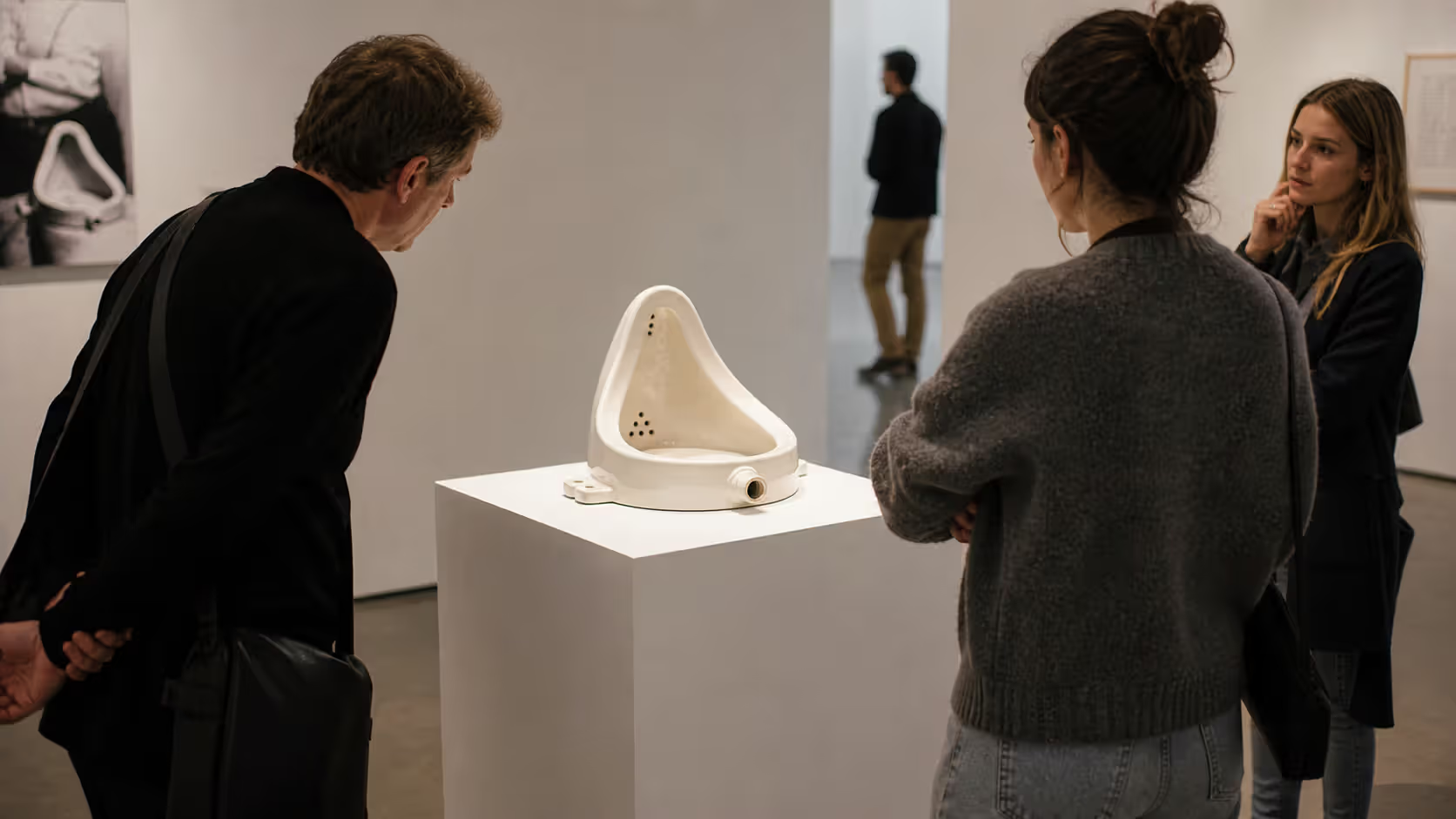
Marcel Duchamp basically predicted all of this in 1917 when he signed a urinal "R. Mutt" and tried exhibiting it as sculpture. That porcelain prank established a crucial precedent: an artist's declaration could transform ordinary objects into art. If a urinal could be art just because Duchamp said so, then art existed more in the designation than the object.
But conceptualism as a full movement crystallized between 1965 and 1972. Artists in multiple cities independently reached similar conclusions—New York, Los Angeles, London, Tokyo. Something in the cultural atmosphere made the time right.
Lawrence Weiner created works consisting entirely of language: "A 36" x 36" removal to the lathing or support wall of plaster or wallboard from a wall." That's the whole piece. Whether anyone actually removes wallboard doesn't matter. The description constitutes the artwork.
On Kawara painted the date on canvas every day he worked. Just the date, precisely rendered. He sent telegrams to people reading "I AM STILL ALIVE." He documented every person he met. This systematic recording of existence—stripped of drama or emotion—made consciousness itself the subject.
Several factors converged. Minimalism had already reduced sculptures to simple geometric forms, suggesting maybe you could reduce further to nothing physical. Pop Art blurred lines between high culture and commercial imagery. Performance art and Happenings introduced temporary, time-based work that couldn't be collected traditionally.
Political context mattered enormously. Vietnam War protests, civil rights struggles, anti-establishment sentiment—many artists felt making beautiful objects for wealthy collectors seemed inadequate or even complicit. Conceptual art offered ways to engage political realities directly without creating commodities.
By 1972, contradictions surfaced. Despite resisting commercialization, conceptual works got sold. Galleries marketed documentation. Museums collected certificates. The art market proved remarkably flexible, absorbing even explicitly anti-commercial gestures into its economy.
The movement's influence spread through the 1980s and 1990s. Jenny Holzer projected text onto buildings: "ABUSE OF POWER COMES AS NO SURPRISE." Barbara Kruger combined bold images with confrontational text: "I shop therefore I am." Both maintained conceptualism's emphasis on ideas while engaging broader public audiences beyond galleries.
Hans Haacke and Andrea Fraser developed "institutional critique," investigating museums and galleries as subjects. Haacke revealed which corporations sponsored exhibitions and their political connections. Fraser performed as a museum docent, exaggerating educational rhetoric until it became absurd. They turned the art world's own structures into artwork.
By 2000, conceptual strategies had become standard practice rather than radical gestures. Art schools taught conceptual approaches alongside traditional studio skills. The movement succeeded by expanding what counted as legitimate artistic practice, then becoming absorbed into the establishment it originally challenged.
Author: Olivia Hartwell;
Source: crafterholic.com
Conceptualism in Contemporary Art Today
Conceptualism in 2025 isn't a movement—it's a basic methodology most artists use to some degree. Even painters typically articulate conceptual frameworks for their work now. The revolution became common sense.
Digital technology transformed conceptual practice fundamentally. Artists create works as software, algorithms, or networked interactions. Rafael Lozano-Hemmer builds installations where your heartbeat controls lights, or your shadow triggers sounds. The concept involves making invisible bodily processes visible through technology. The code is as much the artwork as what viewers experience.
Internet connectivity enables global collaboration and instant idea transmission. Amalia Ulman performed an Instagram fiction, posting staged photos suggesting a personality transformation from art student to sugar baby. Her followers couldn't tell performance from reality. The concept explored how social media constructs identity—enacted entirely through an existing platform.
Contemporary conceptual artists tackle urgent issues. Climate change, artificial intelligence, surveillance capitalism, algorithmic bias, social justice. The approach's flexibility allows responding to rapidly shifting conditions.
Tania Bruguera calls her work "behavior art" or "arte útil" (useful art). She established an immigration services office in a museum. Created spaces for political assembly. Taught art as citizenship training in Cuba. Her concepts emphasize political participation over creating objects. Documentation exists, but the artwork is the temporary social situation she enables.
Trevor Paglen photographs classified military sites from distant mountains, images that show almost nothing clearly. He trained machine vision algorithms, then exhibited their attempts to interpret random images, revealing bias embedded in AI. His concepts make invisible systems—surveillance, data collection, automated decision-making—visible intellectually even when they can't be seen directly.
Hito Steyerl combines video essays, installations, and theoretical writing investigating how images circulate in digital capitalism. Her work looks visually sophisticated while maintaining conceptual rigor—demonstrating how contemporary practice often merges approaches previous generations separated.
Challenges persist, naturally. Art world commercialization continues pressuring artists to produce collectible objects. Social media's emphasis on immediate visual impact can undermine conceptual depth—complex ideas don't reduce easily to Instagram posts. Economic precarity makes time-intensive conceptual research difficult without grants or institutional support.
Yet conceptual approaches remain essential for addressing how we actually live now. Reality gets increasingly mediated by technology, shaped by invisible algorithms and global systems. Art that investigates ideas, structures, and meaning-making processes offers critical tools for understanding these conditions.
Author: Olivia Hartwell;
Source: crafterholic.com
Common Questions About Conceptual Artists
Do conceptual artists make physical art?
Sometimes, but the physical components exist as tools for communicating ideas rather than as ends themselves. A conceptual artist might create elaborate installations or sculptures, but these function as documentation or demonstration of concepts. The crucial difference: traditional artists develop ideas through making things, while conceptual artists determine ideas first, then select appropriate forms. Some conceptual works exist only as written instructions or proposals, remaining deliberately unrealized because the concept doesn't require physical form. That absence is intentional, not incomplete.
What skills does a conceptual artist need?
Critical thinking and articulation ability matter most. You need to develop ideas with genuine intellectual rigor, understanding philosophical and theoretical contexts relevant to your work. Strong writing helps tremendously—vague concepts disguised by obscure language fool nobody for long. Research skills enable investigating subjects thoroughly before proposing artistic responses. Familiarity with various media helps you choose appropriate forms for different concepts. Technical skills remain valuable—many conceptual artists possess strong craft abilities—but technique serves ideas rather than existing for its own sake. Strategic thinking matters too: figuring out how to communicate complex concepts effectively.
Is conceptual art still relevant today?
More relevant than ever, though it's evolved significantly since the 1960s. Contemporary challenges—algorithmic bias, climate crisis, surveillance systems, misinformation—demand the analytical approaches conceptual art provides. As technology mediates more of daily life, art investigating systems, meanings, and invisible structures becomes increasingly vital. The approach has influenced fields beyond art: design thinking, user experience research, creative problem-solving in business all share conceptualism's emphasis on ideas and processes. Rather than declining, conceptual strategies have become foundational to creative practice across multiple disciplines. The question isn't whether it's relevant, but how to deploy it effectively.
How do conceptual artists make money?
Income sources vary dramatically. Some sell documentation, certificates, or instruction-based works through galleries—though this contradicts conceptualism's anti-commercial origins. Museums and private collectors commission site-specific pieces or acquire reproduction rights. University teaching positions provide stable income for many conceptual artists, allowing research-intensive practice. Grants and residencies fund specific projects. Some artists work "day jobs" in related fields—graphic design, writing, consulting—supporting their practice separately. Others embrace financial precarity as part of their critique of commercialization. The challenge: conceptual art's resistance to commodification conflicts with economic necessity, forcing artists to navigate these tensions individually without clear solutions.
What's the difference between conceptual art and abstract art?
Abstract art eliminates recognizable imagery while emphasizing visual experience—color relationships, compositional balance, texture, form. Abstract painters care intensely about how work looks and feels aesthetically. Mark Rothko wanted viewers emotionally overwhelmed by color fields. That's about sensory experience. Conceptual art prioritizes intellectual engagement over visual pleasure. A conceptual work might look unremarkable aesthetically because beauty isn't the objective. Joseph Kosuth's chair-photo-definition piece isn't trying to look good. Abstract art asks viewers to engage perception in new ways; conceptual art asks viewers to engage ideas and question assumptions. An abstract painting succeeds through visual impact; conceptual work succeeds through intellectual clarity. Contemporary practice often combines both—strong concepts executed with aesthetic sophistication—but the fundamental difference involves whether you prioritize sensory experience or intellectual content.
Can anyone be a conceptual artist?
Theoretically yes, since you don't need specialized technical training in painting or sculpture. But that doesn't make it easier—just different. Being an effective conceptual artist demands intellectual rigor, theoretical knowledge, and articulation ability. You must understand art history, contemporary discourse, and relevant philosophical or political contexts informing your work. Simply having ideas doesn't suffice—those ideas require development, refinement, and clear communication. The barrier is intellectual rather than technical. Strong conceptual work needs years of reading, thinking, and practicing idea formulation. Anyone can try, but succeeding requires serious intellectual engagement, not just cleverness or opinions.
Conceptual artists fundamentally changed what art can be and what it can accomplish. By insisting ideas matter more than objects, they expanded artistic practice beyond traditional materials and techniques into territory where thought itself becomes the medium.
This offers powerful tools for engaging contemporary complexity. When reality gets shaped by invisible algorithms, global financial systems, and abstract data structures, art investigating ideas and systems provides essential critical perspective. Making beautiful paintings seems inadequate when the problems we face resist visualization entirely.
Understanding conceptual artists requires recognizing that their creative labor happens primarily through thinking, researching, and conceptualizing rather than making objects. The work exists in the idea whether or not anyone builds it physically. This challenges conventional assumptions about creativity, but that challenge generates value—forcing reconsideration of what art means and how it functions culturally.
For anyone interested in conceptual practice, the path forward involves intellectual development as much as artistic training. Read philosophy, theory, and critical writing. Think systematically about contemporary issues. Practice articulating ideas with precision and clarity. The concept is your material—refine it with the same care a painter applies to brushstroke quality.
The conceptual artist's legacy extends well beyond gallery walls. Their emphasis on ideas, processes, and critical thinking influenced how people approach creativity across fields. In a world increasingly shaped by concepts—from software architecture to social systems—the conceptual artist's skills and perspectives become ever more relevant.
Whether conceptual art fully democratized creativity or just created new forms of exclusion remains debatable. But it definitely proved that art could exist as thought, that ideas could be artworks, and that questioning fundamental assumptions about creativity itself was not just valid but necessary. That contribution alone justifies the sometimes frustrating, occasionally pretentious, frequently challenging work conceptual artists continue producing.
Media arts harnesses electronic technologies and digital tools to create experiences that challenge traditional art forms. From immersive installations to interactive environments, this dynamic field transforms how we perceive and engage with contemporary artistic expression through video, performance, and screen-based work.
Text message art transforms written language into visual compositions. From ASCII characters to monumental installations, artists use typography, concrete poetry, and calligraphy to create work where words function as both message and image, challenging traditional boundaries between reading and viewing.
Writing about your artwork feels awkward at first. You're translating visual ideas into sentences that don't sound pretentious. Every art student faces this challenge for applications, portfolios, and exhibitions. See real examples and learn the structure that works.
De Stijl emerged in 1917 Netherlands with a radical vision: reduce art to horizontal and vertical lines, primary colors, and geometric forms to reveal universal harmony. This Dutch abstract art movement transformed painting, architecture, and design, creating a visual language that still shapes our world.
The content on this website is provided for general informational and educational purposes only. It is intended to explain concepts related to digital design, visual art, color theory, art techniques, design principles, and design history.
All information on this website, including articles, guides, and examples, is presented for general educational purposes. Creative outcomes may vary depending on individual skill, tools, and practice.
This website does not provide professional design services or guarantee results, and the information presented should not be used as a substitute for formal education or professional consultation.
The website and its authors are not responsible for any errors or omissions, or for any outcomes resulting from decisions made based on the information provided on this website.