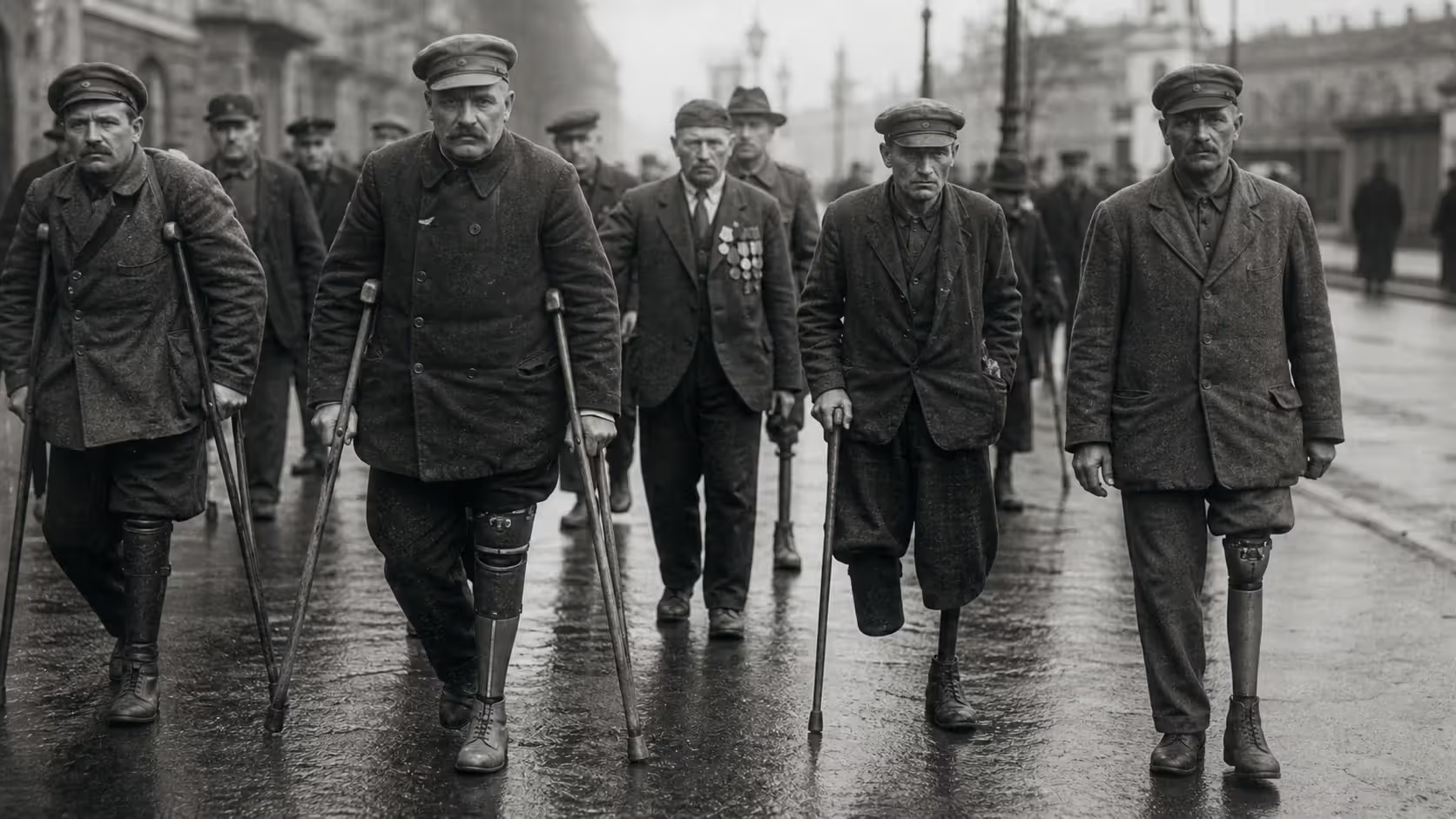
Imagine you're an artist in 1920s Germany. For the past twenty years, you've watched your colleagues paint swirling emotional storms—Expressionists convinced their wild brushstrokes could save humanity's soul. Then you look out your window at actual Germany: disabled veterans begging on corners, politicians brawling in parliament, your neighbors burning cash for warmth because it's cheaper than coal.
You'd probably think: maybe we should paint what's actually happening.
That's essentially how Neue Sachlichkeit started. Museum director Gustav Friedrich Hartlaub coined the name in 1925 when organizing an exhibition at Mannheim's Kunsthalle. He called it "Neue Sachlichkeit: German Painting Since Expressionism" and gathered artists who'd ditched emotional pyrotechnics for something radically different: accuracy.
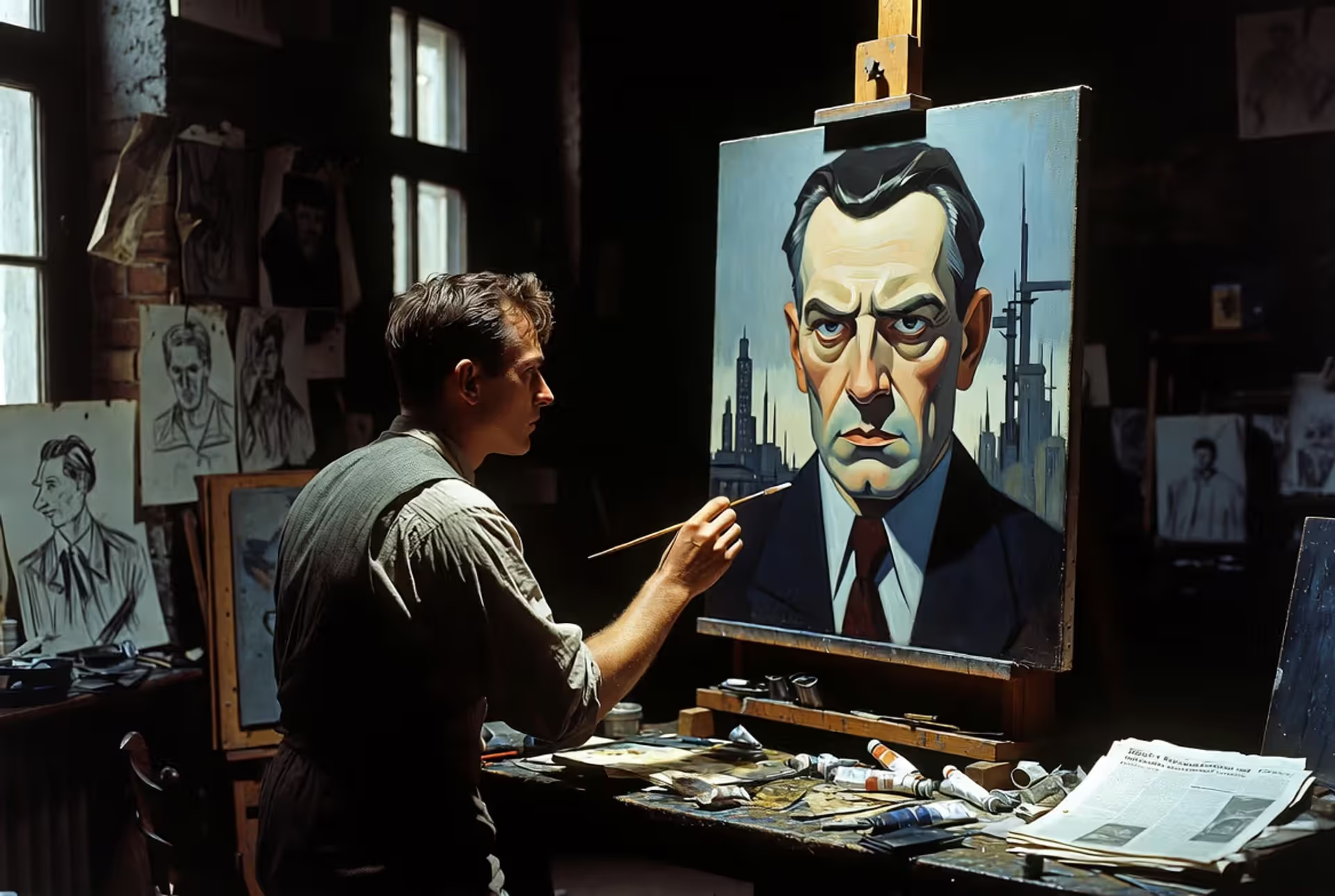
These painters shared one principle. Modern life was grotesque enough without artistic embellishment. So they painted prostitutes, war profiteers, and unemployed workers like medical examiners documenting evidence. Clean lines. Smooth surfaces. No visible brushstrokes (those screamed "self-expression," which they'd rejected completely).
The movement lasted barely thirteen years—1920 to 1933, when Hitler's government branded the work "degenerate" and shut everything down. But during that window, the neue sachlichkeit art movement created a powerful realist response to expressionism that still makes viewers uncomfortable today.
Here's what makes Sachlichkeit tricky to translate. In German, it bundles together objectivity, practicality, and a kind of businesslike efficiency. These artists weren't just documenting reality—they approached painting with an accountant's detachment. Where's the transcendent spiritual meaning? Don't care. What about the artist's inner feelings? Irrelevant. Just show what's there.
Feature
New Objectivity
Expressionism
Emotional approach
Detached, clinical observation
Intense personal feeling
Subject matter
Unemployment offices, brothels, political corruption
Spiritual landscapes, apocalyptic visions
Color palette
Muted tones matching actual appearances
Blazing yellows, electric blues, unnatural greens
Brushwork
Invisible—smooth as a photograph
Visible, energetic, part of the message
Political stance
Sharp social satire, often vicious
Utopian dreams or apolitical mysticism
Time period
1920s until Nazi suppression in 1933
1905 through the early 1920s
Notice how completely they reversed Expressionism's priorities. Ernst Ludwig Kirchner wanted ecstatic color revelations. Otto Dix? He wanted you to see exactly what a syphilitic prostitute's face looked like under harsh electric light. No metaphors. No comfort.
Historical Context of the Weimar Republic
Understanding the weimar republic art context means grasping just how spectacularly Germany was falling apart.
November 1918: Germany loses World War I after four years of mechanized slaughter killed two million German soldiers. The Treaty of Versailles doesn't just end the war—it humiliates. Germany loses 13% of its European territory, all overseas colonies, and gets handed a reparations bill worth roughly 269 billion gold marks (about $33 billion then, over $500 billion in today's money).
What followed wasn't just political instability. It was mayhem.
Communist revolutionaries seized Munich in 1919, establishing a short-lived soviet republic. Right-wing Freikorps paramilitaries crushed them, then started assassinating democratic politicians. They murdered Matthias Erzberger (who signed the armistice) in 1921 and Foreign Minister Walther Rathenau in 1922. Street battles between fascists and communists turned Berlin and Hamburg into war zones with regular gunfights.
Then came the hyperinflation of 1923. Not regular inflation—hyperinflation so extreme it defies comprehension. In January 1923, a loaf of bread cost 250 marks. By November, the same loaf cost 200 billion marks. Workers demanded payment twice daily because their morning wages couldn't buy lunch by afternoon. Middle-class families that had saved for decades watched their entire wealth evaporate in months.
Life savings became worthless overnight. Traditional values—thrift, discipline, hard work—turned into cruel jokes. Why save when money loses half its value before dinner?
This environment completely shaped german art between the wars. The Expressionists' prewar optimism seemed pathetically naive. Wassily Kandinsky thought abstract painting could trigger spiritual awakening. Franz Marc believed art would redeem humanity. Then industrial warfare ground a generation into mud, and the peacetime economy proved even more surreal than battlefield nightmares.
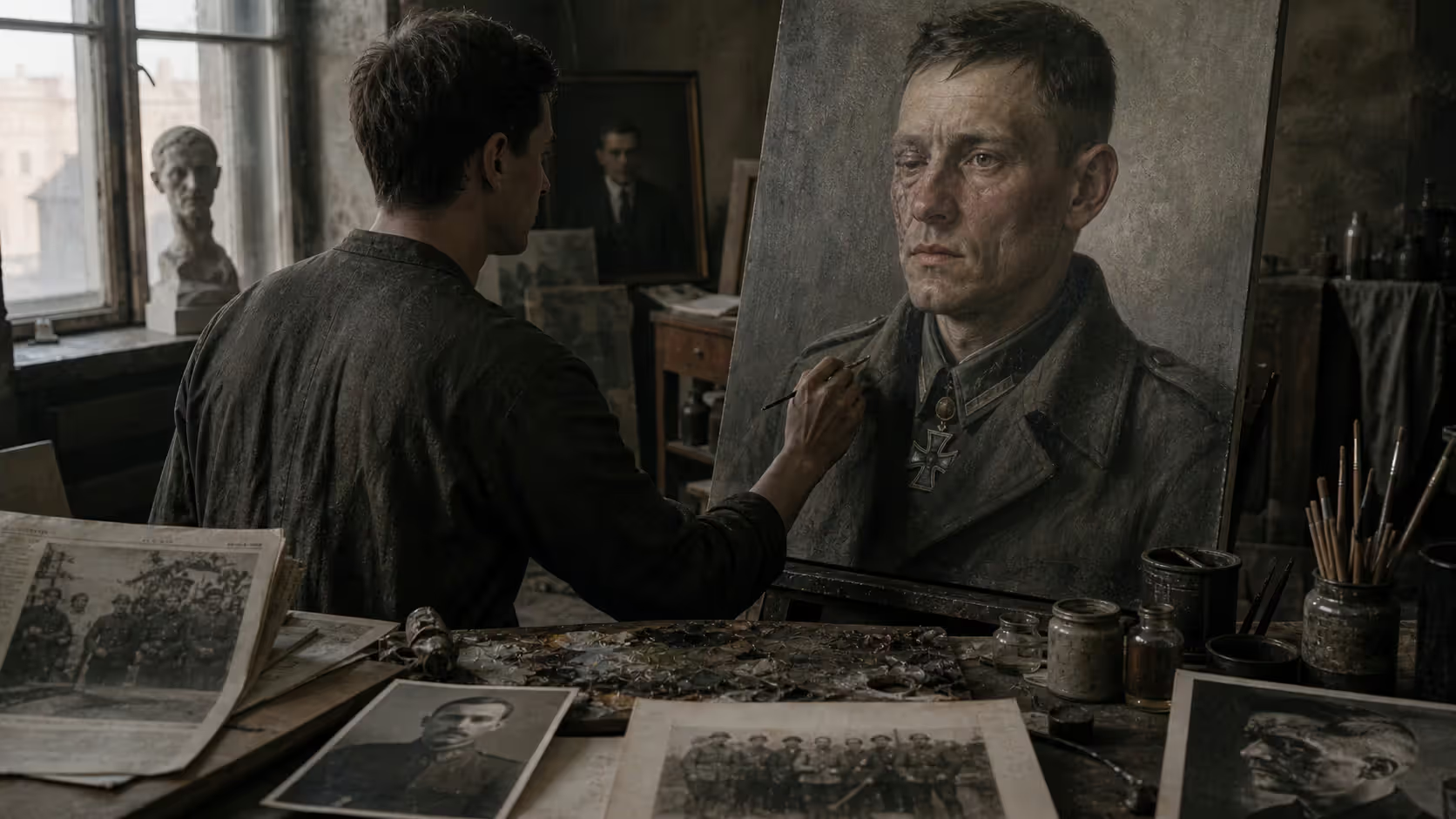
Cold realism in painting emerged directly from this disillusionment. Otto Dix served as a machine gunner. He watched friends blown apart, killed people himself, survived poison gas attacks. After that, painting a disabled veteran missing both legs and begging wasn't shock tactics. It was Tuesday.
The Weimar Republic also modernized at breakneck speed, which split German culture down the middle. Berlin got jazz clubs, avant-garde theater, openly gay nightlife, experimental film. Meanwhile, rural Bavaria clung to traditional Catholic conservatism. This clash—cosmopolitan modernity versus traditional values—gave artists endless material.
The republic's fractured democracy allowed more press freedom than Imperial Germany or Nazi Germany would permit. Artists could actually criticize power without immediate arrest (though they faced obscenity trials and censorship attempts). This brief opening enabled George Grosz's savage political cartoons and Otto Dix's unflinching war paintings.
Author: Sophie Calder;
Source: crafterholic.com
Key Characteristics and Styles
New Objectivity split into two camps that shared technical precision but pursued different goals.
The verist wing—verist from the Italian "vero," meaning truth—practiced aggressive social realism in painting. George Grosz and Otto Dix led this approach. They created grotesque realism in art by exaggerating features until moral corruption became physically visible. A war profiteer didn't just look wealthy—he looked swollen, piggish, ready to explode from greed.
Verists worked like visual prosecutors building cases against German society. Harsh lighting. Compositions forcing you uncomfortably close to subjects. Grosz's 1926 "Pillars of Society" places bloated, scar-faced men representing Germany's ruling class directly in your face. One has a chamber pot for a head because subtlety wasn't the point. The painting screams: these monsters run your country.
This political satire in art used distortion strategically—not for emotional expression but diagnostic precision. Make corruption visible. Force viewers to see what polite society ignored.
The classicist wing developed what critic Franz Roh called "magic realism"—nothing to do with later Latin American literature. This magic realism art style presented mundane objects with such extreme clarity they became unsettling and strange. Christian Schad painted fashionable Berliners so precisely they looked like enigmatic icons from another dimension.
Classicist artists favored frozen moments and glassy surfaces. Where verists shouted social criticism, classicists whispered psychological disturbance. A magic realist painting might show a completely ordinary room where nothing's obviously wrong, yet something feels deeply off. The light's too even. Shadows fall incorrectly. Time seems suspended.
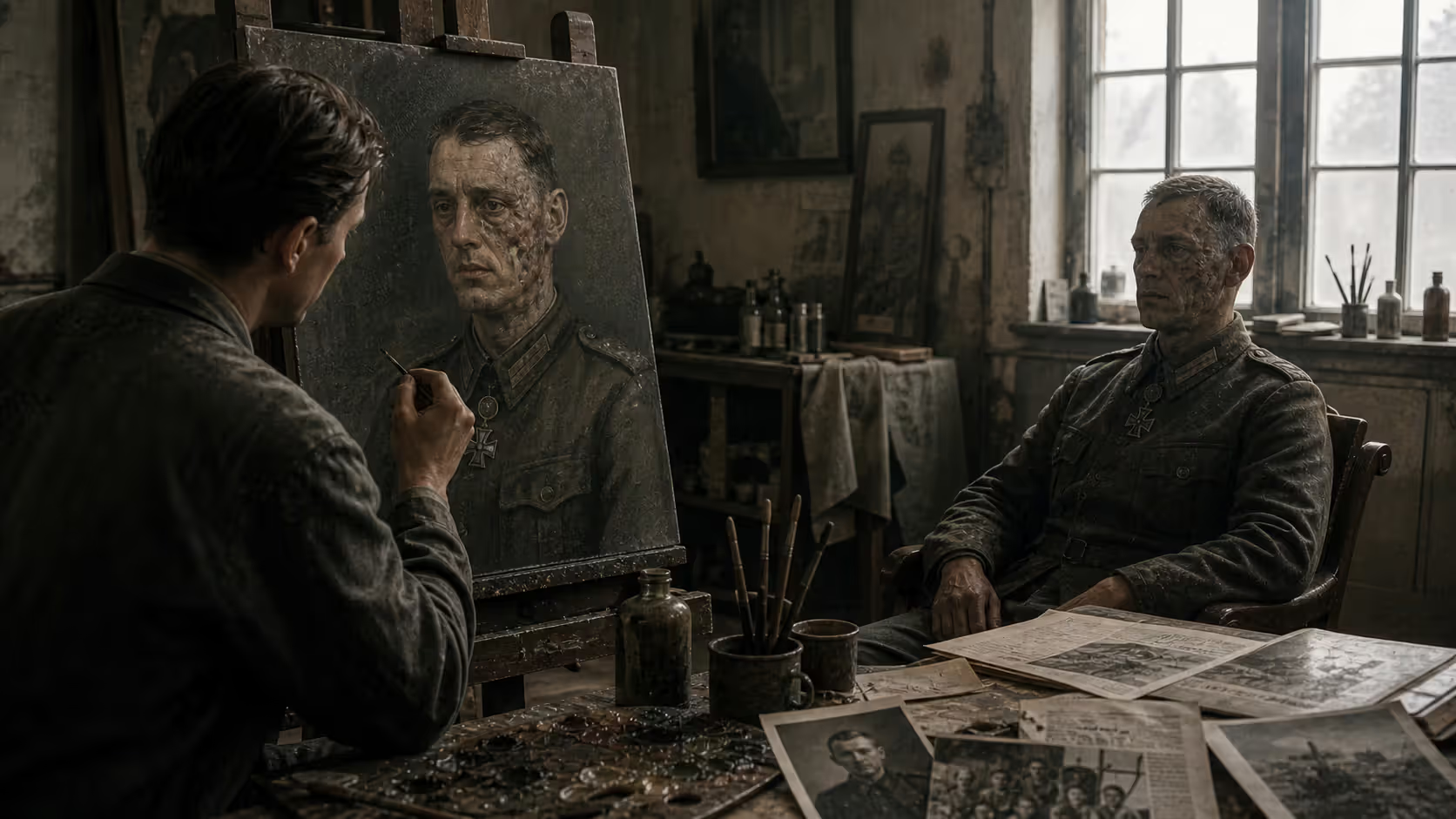
Both wings shared technical obsessions defining cold realism in painting. Artists used traditional Old Master glazing techniques—building translucent layers of oil paint to create luminous, enamel-smooth finishes. Visible brushwork? That's romantic self-expression. They wanted photography's mechanical impersonality.
With the Expressionists, objects had lost their value as things and were transmuted into mere symbols of inner feelings. Now objects reappear, and the artist accepts the world as it is.
— Franz Roh
Acceptance didn't mean approval—just refusal to prettify reality or spiritualize suffering.
The documentary approach extended to subject selection. These artists painted only contemporary life. No historical scenes. No mythology. You got city streets in 1927, nightclubs in 1929, unemployment lines in 1930. They portrayed specific social types—the disabled veteran, the sex worker, the factory foreman—with anthropological detachment.
This relentless focus on the immediate present, stripped of any historical comfort or mythological escape, reinforced their anti romantic art movement stance completely.
Author: Sophie Calder;
Source: crafterholic.com
Major Artists and Their Work
George Grosz brought savage humor to indicting German society. He faced prosecution three times—twice for blasphemy, once for insulting the military—because his paintings and drawings portrayed ruling elites as grotesque monsters barely disguised as humans.
"Pillars of Society" (1926) shows what Grosz did best. A newspaper editor sits with his brain visible through a transparent skull—it's filled with excrement. A Social Democratic politician preaches peace while nursing a bloody sword. A nationalist academic has a chamber pot on his head and a swastika pin on his chest. Grosz combined Renaissance-level draftsmanship with venomous social commentary, creating political satire in art that mixed technical brilliance with pure rage.
He emigrated to America in 1933, correctly predicting Nazi Germany would eliminate his kind of work. They proved him right by confiscating and destroying hundreds of his pieces in the "Degenerate Art" purge.
Otto Dix created some of modern art's most brutal images because he'd experienced brutality firsthand. Four years as a machine gunner on the Western Front gave him intimate knowledge of industrialized death. His war paintings don't glorify or sentimentalize—they document.
"War Cripples" (1920) shows four disabled veterans in a city street. One's blind. One lost his jaw. One has a mechanical jaw replacement. One's missing limbs. They're not noble wounded heroes. They're destroyed men society would rather not see, painted with forensic accuracy.
His triptych "Metropolis" (1927-28) documented Weimar Berlin's nightlife with zero romanticism. Jazz musicians, sex workers, pleasure-seekers bathed in harsh electric light. The technical mastery approaches Old Masters—Dix studied Renaissance glazing methods, building translucent layers for luminous surfaces. But he applied techniques developed for religious altarpieces to prostitutes and profiteers, which scandalized conservatives perfectly.
Christian Schad developed distinctive magic realist portraits. His paintings presented fashionable Weimar figures with such intense clarity they became enigmatic rather than documentary. "Portrait of Dr. Haustein" (1928) shows a stern man with a monocle rendered in perfect detail. Every wrinkle, every hair. Yet somehow the overall effect feels dreamlike, psychologically ambiguous.
Schad pioneered the "Schadograph"—cameraless photography placing objects directly on light-sensitive paper—before turning to painting. His painted work retained photography's precision while adding subtle wrongness. Perspectives slightly compressed. Spaces flattened oddly. Stillness so complete it feels supernatural.
Max Beckmann occupied complicated territory between Expressionism and New Objectivity. His paintings combined precise observation with psychological intensity exceeding documentary realism. "The Night" (1918-19) shows contemporary violence through claustrophobic compositions that trap figures in nightmarish scenarios rendered with disturbing clarity.
Beckmann's self-portraits, painted throughout his career, presented the artist as a detached modern observer rather than romantic genius. He appears in formal evening wear or business suits, regarding viewers with cool assessment. Where Expressionist self-portraits revealed inner turmoil through distorted features and wild colors, Beckmann showed himself as impeccably dressed and emotionally unreadable.
Other significant figures included Franz Radziwill, whose magic realist landscapes combined photographic precision with ominous atmospheres suggesting imminent catastrophe, and Alexander Kanoldt, whose still lifes made ordinary bottles and fruit mysterious and charged with unstated menace.
Author: Sophie Calder;
Source: crafterholic.com
New Objectivity's Influence and Legacy
New Objectivity's impact spread globally, influencing social realism movements throughout the 1930s and beyond. American artists during the Depression—Ben Shahn, Isabel Bishop, the Soyer brothers—adopted similar strategies combining documentary precision with social criticism. The movement proved realist painting could address contemporary issues without sacrificing artistic sophistication or collapsing into propaganda.
The Nazi regime's 1933 suppression paradoxically guaranteed New Objectivity's lasting influence. Branding it "degenerate art" alongside Expressionism and other modernist movements, the regime yanked works from museums while many artists fled. This diaspora spread the movement's ideas internationally. Grosz's emigration to America brought his satirical approach to new audiences. Max Beckmann ended up in Amsterdam, then eventually America. Other artists carried New Objectivity principles to England, France, wherever they could escape.
The 1937 "Degenerate Art" exhibition in Munich—intended to mock modernism—accidentally documented the richness of german art between the wars. Over 650 works by Dix, Grosz, Beckmann, and other New Objectivity artists hung alongside Expressionist and abstract pieces as supposed examples of cultural decline. Two million people saw the exhibition. The regime wanted condemnation. Many visitors saw suppressed brilliance instead.
After 1945, New Objectivity influenced various realist revivals. Britain's Kitchen Sink painters in the 1950s—John Bratby, Derrick Greaves—shared its commitment to depicting working-class life without romanticism or condescension. American Photorealists in the 1970s, though politically quite different, adopted similar technical approaches for rendering contemporary reality with mechanical precision.
Contemporary political art continues New Objectivity's legacy. Artists addressing inequality, war, or environmental destruction often employ the movement's core strategy: present reality clearly enough that viewers can't avoid uncomfortable truths. Jenny Saville's confrontational figure paintings, Kehinde Wiley's technical precision applied to critique, various documentary photography movements—they all owe debts to New Objectivity's combination of traditional skill with contemporary social criticism.
The movement's influence on figurative painting persists in art schools and museums worldwide. Major retrospectives at MoMA (1960s), the Guggenheim (2015), and various German museums have examined its achievements. The work retains its capacity to disturb and provoke nearly a century later, proving that cold assessment of human society transcends specific historical moments.
Author: Sophie Calder;
Source: crafterholic.com
New Objectivity also contributed to ongoing debates about art's relationship to politics. The movement demonstrated political art need not be propagandistic or didactic—that careful observation itself constitutes critique. This lesson remains relevant for contemporary artists navigating relationships between aesthetic quality and social engagement without collapsing into either pure formalism or illustration.
FAQ
What does Neue Sachlichkeit mean in English?
It translates literally as "New Objectivity" or "New Sobriety," but German packs more meaning into Sachlichkeit than English captures in one word. It bundles together objectivity, matter-of-factness, practicality, and businesslike efficiency. Artists chose the term to emphasize rejecting emotional expression for detached, accurate observation of reality as it existed.
How did New Objectivity differ from Expressionism?
Pretty much completely. Expressionists used distorted forms and brilliant, unnatural colors to express inner feelings and spiritual visions. New Objectivity artists employed precise, almost photographic techniques documenting external reality with clinical detachment. Where Expressionism sought transcendence and spiritual truth, New Objectivity insisted on facing the world exactly as it existed—pleasant or absolutely not.
Why did New Objectivity end?
Nazi consolidation in 1933 killed it abruptly. The regime condemned New Objectivity as "degenerate art," removing works from museums and persecuting artists. Many practitioners fled Germany—Grosz to America, Beckmann to Amsterdam. Those who stayed faced censorship, professional destruction, or worse. The political and cultural conditions that enabled New Objectivity's critical stance disappeared entirely under totalitarian control.
Was New Objectivity only a painting movement?
No, though painting dominated. New Objectivity influenced photography significantly—August Sander's systematic documentary portraits of German social types directly paralleled painting's approach. The movement also affected literature (Alfred Döblin's "Berlin Alexanderplatz"), theater (Bertolt Brecht's early work), and architecture. The Bauhaus school shared New Objectivity's emphasis on functionality and rejection of romantic decoration, though the movements developed separately with distinct goals.
How did the Weimar Republic influence New Objectivity?
The republic's chaos directly shaped everything. Postwar disillusionment, devastating hyperinflation in 1923, street violence between political extremists, rapid modernization clashing with traditional values—all this pushed artists toward documentary realism. Why paint spiritual visions when actual reality looked more surreal than any fantasy? The republic's relative cultural freedom (compared to Imperial or Nazi Germany) also allowed critical work that wouldn't have been possible under more authoritarian regimes.
What is the difference between magic realism and verist styles in New Objectivity?
Verists like Grosz and Dix pursued aggressive social criticism through grotesque exaggeration and satirical distortion. They documented poverty, corruption, and social problems with prosecutorial intensity. Magic realists like Schad presented ordinary subjects with such extreme precision they became strange and psychologically unsettling. Magic realism created unease through uncanny clarity rather than obvious distortion—everything perfectly rendered yet somehow deeply wrong. Both rejected romantic emotion but used completely different artistic strategies to achieve it.
New Objectivity marks the moment when German artists abandoned romantic illusions to confront modern reality with unflinching precision. Born from World War I's devastation and Weimar Germany's spectacular chaos, the movement developed two approaches—verist social criticism and magic realist psychological unease—united by technical mastery and documentary commitment.
The neue sachlichkeit art movement's brief flowering from 1920 to 1933 produced works that retain their power to disturb nearly a century later. Otto Dix's war cripples, George Grosz's corrupt officials, and Christian Schad's enigmatic portraits still challenge viewers to see past comfortable fictions and social denial.
These artists proved realism could be as radical as abstraction when deployed with intelligence, courage, and surgical precision. Traditional techniques developed for religious art—Renaissance glazing methods, Old Master compositions—got repurposed to document prostitutes, profiteers, and the broken bodies of mechanized warfare.
Understanding New Objectivity deepens our grasp of how art responds to social crisis and political catastrophe. The movement's cold assessment of human behavior and social structures offers strategies for contemporary artists addressing current challenges. Its suppression by the Nazi regime reminds us that authoritarian movements fear honest observation as much as direct protest—maybe more, since brutal accuracy cuts deeper than slogans.
For anyone studying twentieth-century art, Weimar culture, or the relationship between aesthetics and politics, New Objectivity provides essential insights. Technical excellence and social engagement don't conflict. Clarity can subvert more effectively than distortion. And refusing to look away—that itself becomes resistance.
Media arts harnesses electronic technologies and digital tools to create experiences that challenge traditional art forms. From immersive installations to interactive environments, this dynamic field transforms how we perceive and engage with contemporary artistic expression through video, performance, and screen-based work.
A conceptual artist creates work where the underlying idea holds more importance than the finished physical object. Unlike traditional artists who focus on mastering materials, conceptual artists treat the concept itself as the artwork, with execution serving merely as documentation of the idea.
Text message art transforms written language into visual compositions. From ASCII characters to monumental installations, artists use typography, concrete poetry, and calligraphy to create work where words function as both message and image, challenging traditional boundaries between reading and viewing.
Writing about your artwork feels awkward at first. You're translating visual ideas into sentences that don't sound pretentious. Every art student faces this challenge for applications, portfolios, and exhibitions. See real examples and learn the structure that works.
The content on this website is provided for general informational and educational purposes only. It is intended to explain concepts related to digital design, visual art, color theory, art techniques, design principles, and design history.
All information on this website, including articles, guides, and examples, is presented for general educational purposes. Creative outcomes may vary depending on individual skill, tools, and practice.
This website does not provide professional design services or guarantee results, and the information presented should not be used as a substitute for formal education or professional consultation.
The website and its authors are not responsible for any errors or omissions, or for any outcomes resulting from decisions made based on the information provided on this website.